
GORDON HARTMAN | Founder and Board Chair
Building a World Where Everyone Belongs
When he was 19, Gordon Hartman ordered a set of house plans from a magazine, bought a lot in a part of San Antonio where he could afford one, and started building — even though he didn’t know how to get a permit.
When a contractor set forms for only three sides of the foundation, Gordon called to point out the mistake.
“I think we need to talk,” the contractor replied.
The fourth side had been left open for the plumber. Gordon didn’t know that. He also didn’t know he needed a plumber yet.
“I had no idea what I was doing,” he recalls. “That’s probably the thing I remember most: I had no idea what I was doing or where it was going, but I built a house.
“By the way, it’s still standing today.”
More than four decades later, the scale of Gordon’s projects has changed considerably. The instinct behind them has not: He sees something that ought to exist, gathers people who can help him, and starts building — often before anyone knows exactly how they’ll get there.
With the little money he made on that first house and the savings from the landscaping business he started at 15, Gordon built a couple more houses. Then seven. Then 20.
Over the next 22 years, Gordon Hartman Homes built housing for moderate-income families and took on projects other builders passed over. Together with the mortgage, title, and insurance companies Gordon later launched, it became San Antonio’s largest locally owned homebuilding and land development enterprise.
Gordon’s drive to use his skills to benefit others was evident. When he learned of families who lost their homes to fires, he would sometimes find them a new lot and build them a new home at no cost — relying on contractors and other partners willing to contribute their skills.
In 2005, Gordon sold his companies and, with his wife Maggie, established the Gordon Hartman Family Foundation to support individuals with cognitive and physical disabilities and their families. The foundation was inspired by their daughter Morgan, who was born with Tatton-Brown-Rahman Syndrome.
Two years later, an experience with Morgan would give Gordon’s instinct to build an entirely new direction.
While on a family vacation, Gordon watched Morgan, who was not yet a teenager, as she approached three children playing with a ball in a swimming pool. She wanted to join them, but she couldn’t ask them. When Morgan hit the ball to signal that she wanted to play, the children took it and climbed out of the water.
“They didn’t understand what Morgan wanted because she wasn’t able to say, ‘Can I play?’” Gordon recalls. “Morgan wasn’t being included, not because she’s a bad person or because the kids are bad. They just didn’t understand.
“I started thinking, how can we make it so that the next time that happens, those children have an opportunity to experience it differently?”
Once again, Gordon had a vision for what he wanted to build. Once again, he had never built anything like it. He rounded up architects, designers, and engineers from his time in the homebuilding business and shared his idea.
“I said, ‘Guys, I want to build a theme park,’” he recalls. “They said, ‘We don’t know how to build a theme park.’ I said, ‘You know what? Neither do I.’
“So we all just joined together and figured out how to do it.”

On April 10, 2010, Morgan’s Wonderland opened as the world’s first Ultra-Accessible™, fully inclusive theme park. The 25-acre park went from an idea to opening day in just 39 months.
Gordon was confident that families like his needed a place designed with them in mind — less crowded and overwhelming than traditional parks — but he didn’t know if other people would actually show up.
The answer quickly became clear. Since it opened, the park has welcomed more than 3.8 million guests from all 50 states and 123 countries.
Morgan’s Wonderland was not created to be a separate place for individuals with disabilities. It was designed to be a place where people with and without disabilities could experience the same rides, attractions, and spaces together.
“We’re not an accessible park,” Gordon says. “We’re an inclusive park.”
The park served the need Gordon initially saw, but the families that came through its gates helped Gordon see many other needs as well. The result is a growing ecosystem designed around the ways individuals with disabilities and their families live, play, work, and receive support:
- Morgan’s Inspiration Island, the world’s first Ultra-Accessible™ splash park, opened in 2017 and was named one of TIME’s World’s Greatest Places.
- Morgan’s Sports and Morgan’s Camp opened in 2021, expanding opportunities for inclusive athletics and adventure.
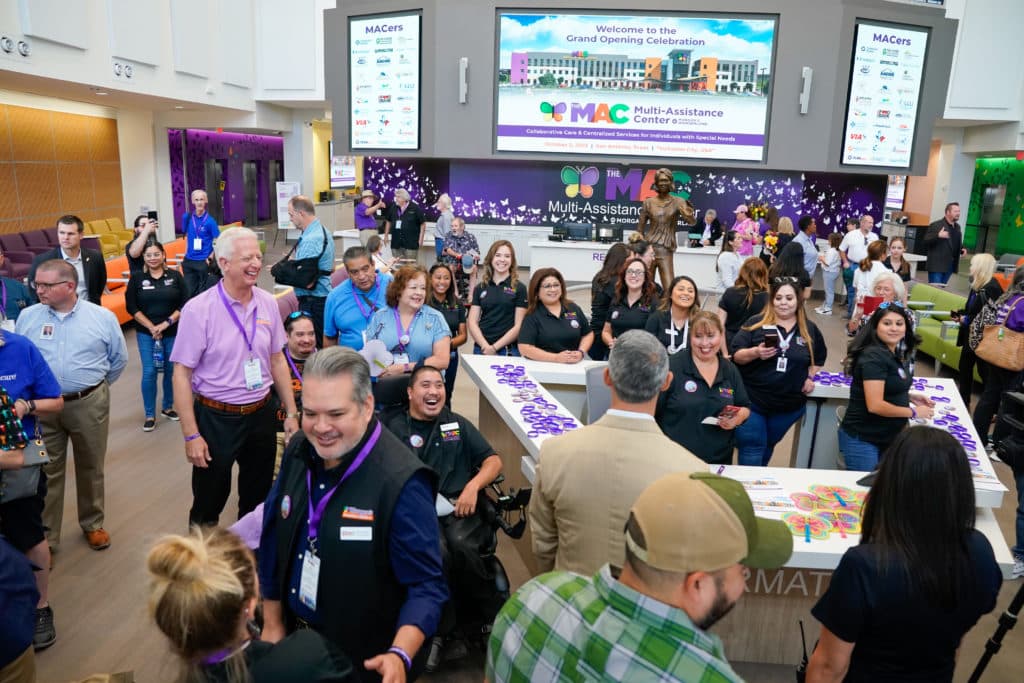
- Morgan’s Multi-Assistance Center (MAC), established in 2022, helps families navigate the fragmented system they face when seeking medical and nonmedical services.
- Morgan’s Inclusion Institute, established in 2024, helps other organizations embed inclusion into their cultures, operations, and experiences.
- Morgan’s Wonder Care, opened in 2026, provides daytime skilled nursing support for children and young adults.
- Morgan’s Hotel™, coming in 2027, is redefining hospitality with its Ultra-Accommodating™ standard, delivering an inclusive, comfortable, and exceptional experience for all travelers.
He and Maggie have raised or contributed more than $303 million in support of inclusive programs. As signatories of The Giving Pledge, they have committed 95% of their financial resources to charitable causes.
While the Morgan’s network has matured and grown alongside its namesake, Gordon’s instincts to use his gifts for good were evident long before his daughter was born. While attending St. Anthony’s Seminary, he was required to devote several hours each week to service in the community. He frequently chose to work with individuals with disabilities, an experience he believes helped him embrace Morgan’s diagnosis without fear.
Gordon has championed accessibility improvements to public buildings throughout San Antonio, contributing to the city’s designation as “Inclusion City, USA.” He received an honorary doctorate in social work from Our Lady of the Lake University and another in pastoral ministry from Oblate School of Theology. In 2019, he received the Governor’s Trophy for lifetime achievement in support of Texans with disabilities. He also has been inducted into four Halls of Fame:
- San Antonio Business Hall of Fame (2012)
- Texas Business Hall of Fame (2016)
- San Antonio Sports Hall of Fame, for his work with Soccer for a Causes (2018)
- International Association of Amusement Parks and Attractions Hall of Fame (2024)
He’s quick to point out, of course, that he’s had an army of people working alongside him at every turn: “All these things I do, this isn’t just Gordon,” he says. “You can’t see them behind me, but there are a lot of people who help everything I do. People go out of their way to say, ‘Hey, let’s make this happen.’
“I have been blessed to be able to bring that out of people.”
Hanging in Gordon’s office is a framed illustration of what happens to an ambitious idea. It begins with excitement, descends into doubt, and eventually reaches what he calls “the dark area,” where the problems seem larger than the original vision. Then the line rises again until it reaches its final words: “We made it happen.”
He uses this image to remind the people gathered around his table that uncertainty is part of building something new.
“I consider myself a very upbeat, positive person,” he says. “When I run into problems, I’m not seeing the problem. I’m seeing what the result will look like.”
It is the same approach he took at 19. The plans are more ambitious, and the size of his crew has grown, but the path is usually the same. He doesn’t have the answers when he starts building, just the vision of something that ought to exist.
His guiding philosophy is simple: “Together, we ARE making a difference.”